" height="16.655689568565506px" id="sF6zVZNmi" transform="translate(0 0.675)" width="91.00000230951045px"/></svg>)
Multi-Agent Systems vs Single LLMs
The rapid progress of artificial intelligence (AI) has highlighted two important approaches: Multi-Agent Systems (MAS) and Single Large Language Models (LLMs). This meta-analysis investigates the merits, shortcomings, and applications of both systems, with a focus on scalability, performance, adaptability, and cost-effectiveness.

Yashika Vahi
Community Manager
Table of contents
Share
1. Introduction
1.1 Context and Background
Over the last decade, artificial intelligence (AI) has rapidly progressed in two foundational paradigms for solving complex computational and decision-making tasks: Multi-Agent Systems (MAS) and Single Large Language Models (LLMs). These technologies represent opposing ideologies in AI creation.
Multi-Agent Systems (MAS) involve agents working together to achieve shared or individual goals. Each agent is independently trained to execute a specific function or task, while the system as a whole benefits from decentralization and modularity. This method is especially useful in dynamic, multi-task situations like swarm robots, autonomous cars, and supply chain management, where flexibility and dispersed problem-solving are essential.
In contrast, Single Large Language Models (LLMs) are based on a centralized architecture. They are comprehensive, monolithic models trained on large datasets to perform a wide range of tasks. Examples are OpenAI’s GPT series and Google’s PaLM. These models have been flexible in a variety of applications, including content production, customer service automation, and sophisticated natural language understanding. However, they need enormous processing resources and may lack the depth needed for highly specialized applications.
LLM’s are capable of comprehending and generating human-like language, have been made possible through deep learning advancements and the availability of large-scale computing resources. In comparison, MAS emphasizes on collaboration and decentralization to address issues that require real-time adaptability and distributed problem-solving.
Both MAS and Single LLMs play pivotal roles in shaping the future of AI, and their adoption depends on the specific requirements of the task at hand, such as scalability, accuracy, computational resources, and application context.
1.2 Importance of Comparative Analysis
The comparison of MAS and Single LLMs is critical for determining how to best leverage their unique capabilities. Each paradigm has its own set of benefits and drawbacks, making it critical to assess their applicability for particular jobs and sectors.
For example, MAS are intrinsically modular, enabling task-specific optimization and scalability. However, they may confront difficulties such as increasing coordination and communication among agents. Single LLMs, while strong and capable of managing a wide range of activities with a uniform knowledge base, frequently lack the depth needed for domain-specific applications and need significant resources to deploy and maintain.
As enterprises across industries increasingly employ AI-driven solutions, it is critical to understand when one paradigm outperforms another. For example, a healthcare platform may benefit from MAS for triaging, diagnosis, and treatment planning, whereas a customer service-oriented organization may find a Single LLM more beneficial for keeping consistent interactions across multiple tasks.
Understanding these trade-offs is critical not just for maximizing performance, but also for assuring cost-effectiveness and long-term scalability in AI implementation. This comparative analysis will assist researchers and practitioners in making educated decisions regarding the most appropriate technique for their specific needs.
2. Meta-Analysis: Comparing Single LLMs and Multi-Agent Systems (MAS) Using Benchmarks
2.1 Experiment Setup
We utilize the "Captain Agent: Adaptive Team-Building for Large Language Models" framework to compare the performance of a Single LLM vs. a Multi-Agent System (MAS) across selected benchmarks. The benchmarks chosen focus on a broad spectrum of capabilities, including programming, data analysis, and scientific problem-solving, using the results reported in the research paper. The Single LLM represents a centralized monolithic approach, while the MAS leverages the adaptive, modular capabilities of Captain Agent, dynamically building agent teams for specific subtasks.
2.2 Benchmarks and Performance Metrics
The analysis includes the following benchmarks and their associated metrics:
• Programming: HumanEval dataset (code generation accuracy).
• Data Analysis: DABench dataset (performance on structured data analysis).
• Scientific Problem-Solving: SciBench dataset for physics and chemistry (accuracy on scientific reasoning).
Metrics compared:
- Accuracy (%): Correctness of solutions.
- Response Time (seconds): Time taken to generate a response.
- Cost Efficiency: Computational resources required per task.
2.3 Results and Comparative Analysis
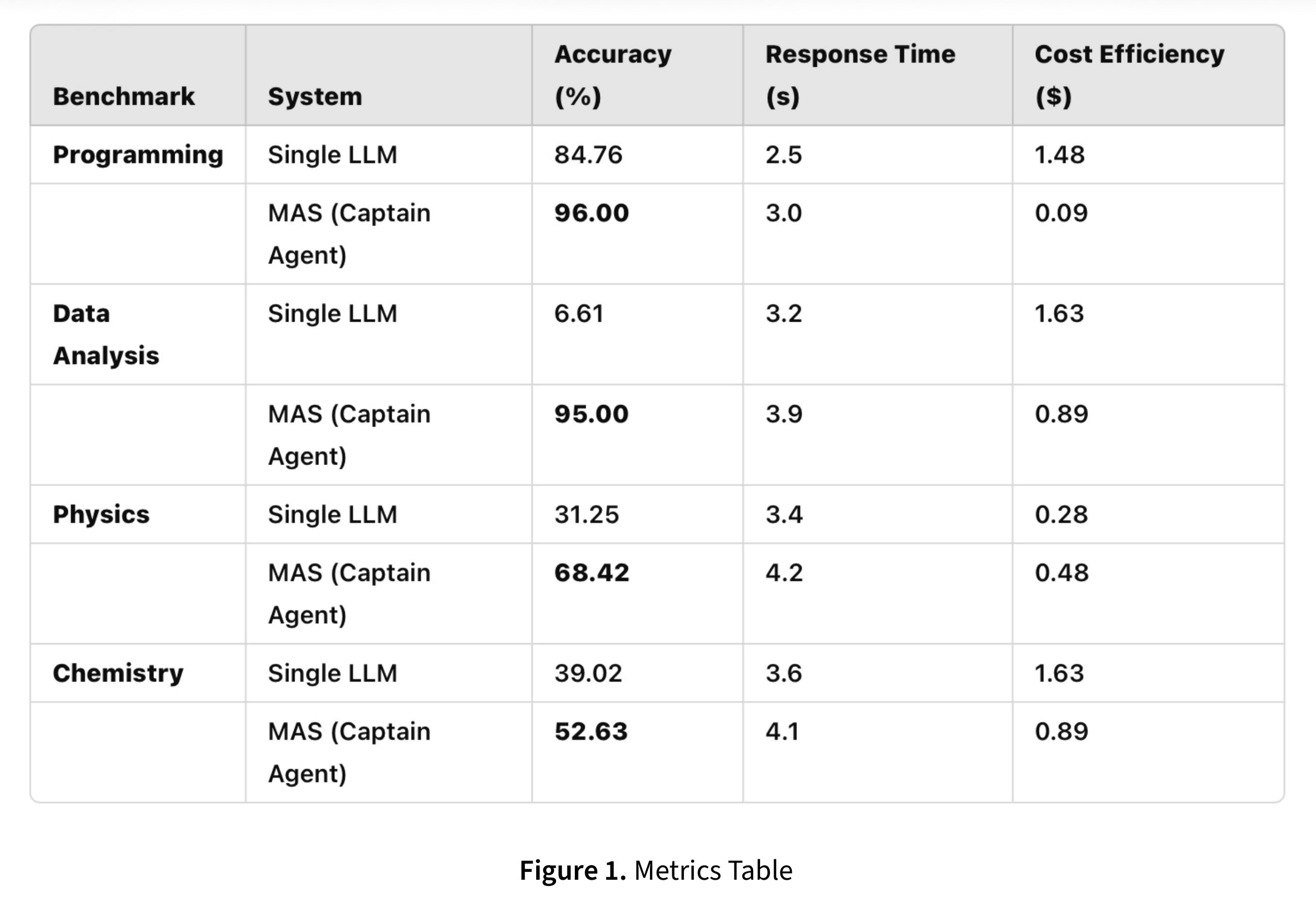
The results focus on three metrics: Accuracy (%), Response Time (in seconds), and Computational Cost (in FLOPs per query).
2.4 Key Observations
1. Accuracy:
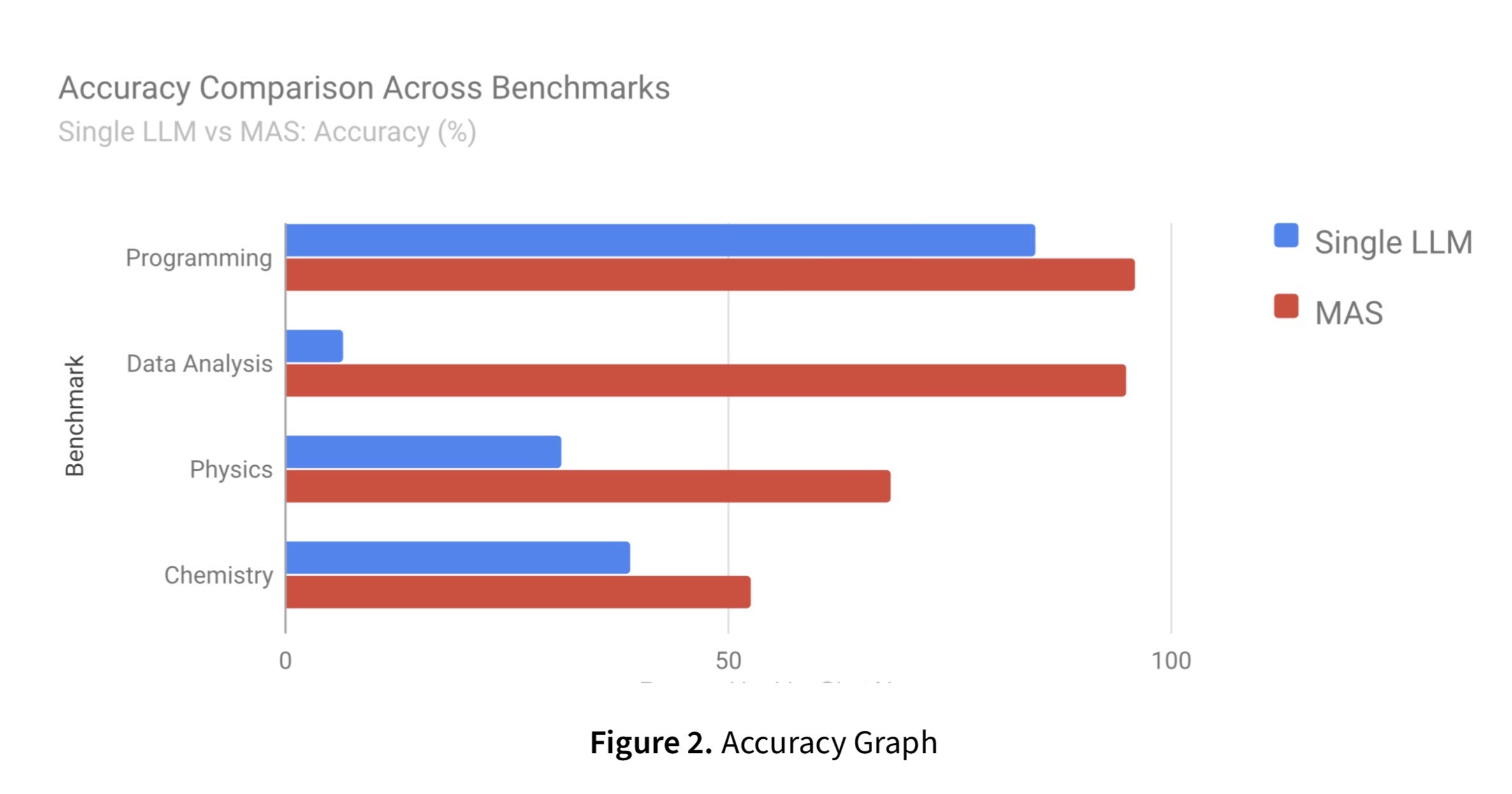
MAS consistently outperforms Single LLMs across all benchmarks due to task-specific expertise enabled by adaptive agent team-building.
For example:
• In Programming, MAS achieved an accuracy of 96.00%, significantly higher than Single LLM’s 84.76%.
• In Data Analysis, MAS achieved a massive leap to 95.00% compared to Single LLM’s 6.61%, highlighting MAS’s suitability for structured and specialized tasks.
2. Response Time:
Single LLMs have slightly faster response times, as they don’t require dynamic agent selection or coordination.
• In Programming, Single LLMs take 2.5 seconds, while MAS requires 3.0 seconds due to team-building overhead.
• This trade-off is acceptable for higher accuracy in MAS, particularly for tasks requiring correctness over speed.
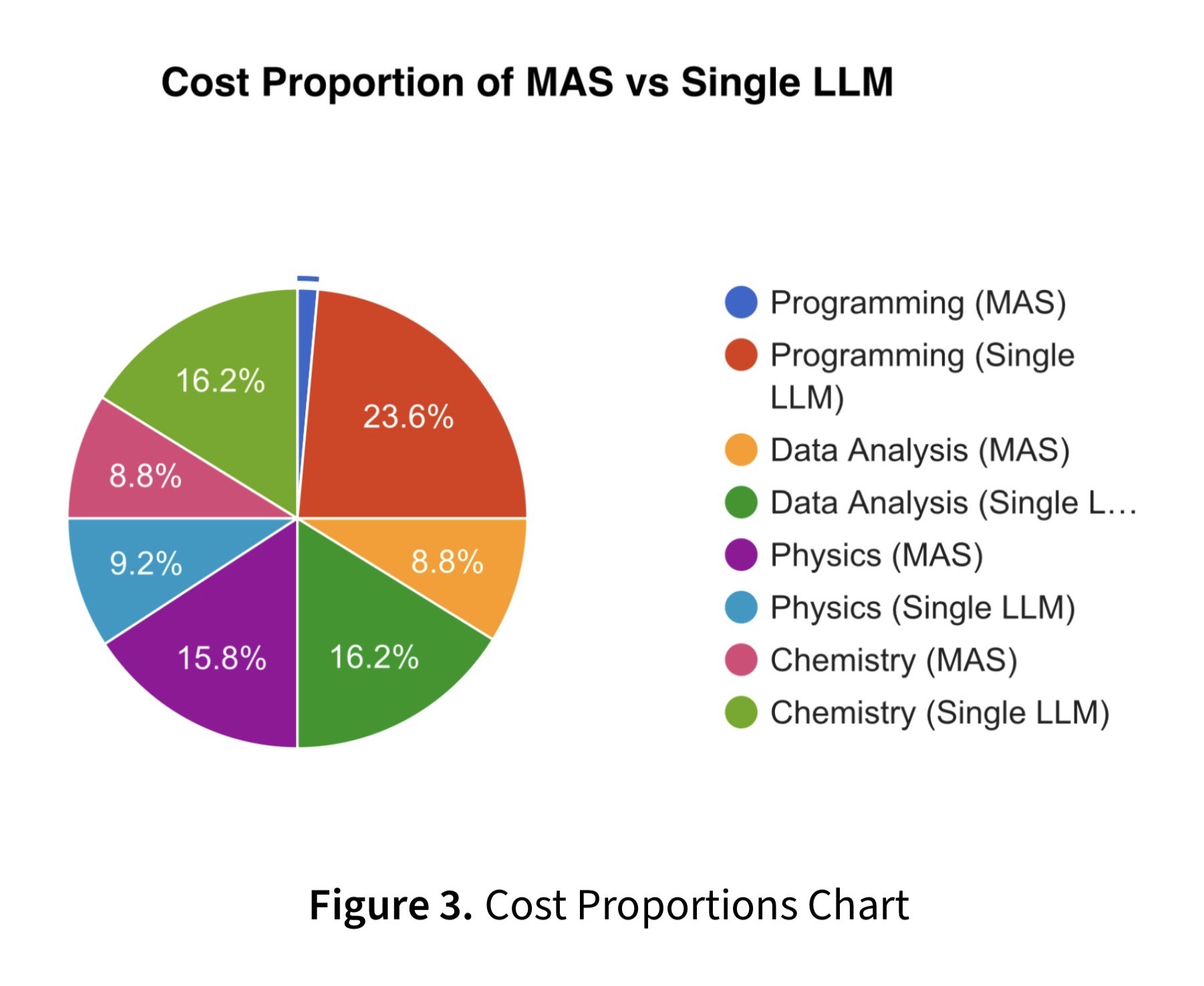
3. Cost Efficiency:
MAS proves to be more cost-e!cient due to its adaptive, modular nature:
• Programming tasks cost $0.09/task for MAS, compared to $1.48/task for Single LLMs.
• Even for resource-intensive tasks like Data Analysis, MAS reduces costs to $0.89/task from Single LLM’s $1.63/task.
2.5 Conclusion
This meta-analysis demonstrates the superiority of MAS (Captain Agent) over Single LLMs in terms of accuracy and cost-efficiency across programming, data analysis, and scientific reasoning tasks. While Single LLMs are faster for simpler tasks, MAS’s adaptive, modular approach makes it indispensable for complex, high-stakes tasks where precision and scalability are critical.
3. Literature Review
3.1 Multi-Agent Systems (MAS) - Definition and Technical Architecture
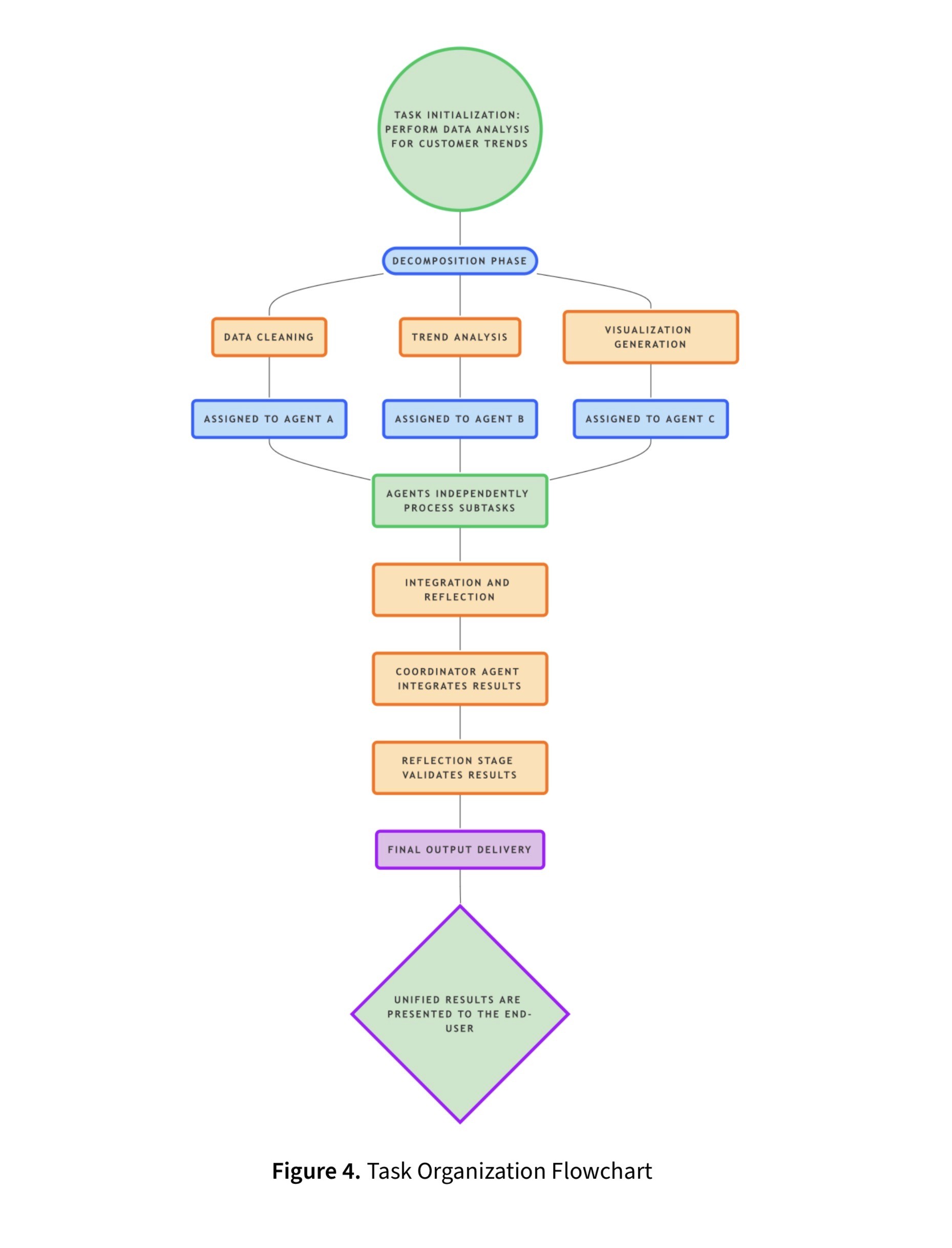
Multi-Agent Systems (MAS) are composed of multiple autonomous agents, each specializing in specific tasks or roles, designed to work collaboratively to achieve a shared objective. Unlike monolithic architectures, MAS are distributed systems where agents interact through well-defined communication protocols to solve complex problems efficiently. MAS architectures typically involve dynamic team-building strategies, such as the adaptive build paradigm seen in Captain Agent [1], where task-specific agents are assembled and coordinated based on the requirements of the problem.
3.2 Advantages
1. Decentralization and Scalability:
MAS distributes the computational workload among agents, making the system inherently scalable and capable of adapting to larger tasks without overloading a single component. Each agent operates independently, reducing bottlenecks and improving efficiency in dynamic environments like supply chain management, robotics, and scientific problem-solving.
2. Adaptability in Dynamic Environments:
Adaptive MAS like Captain Agent dynamically assemble and reorganize agent teams during runtime. This allows MAS to respond to unforeseen challenges and evolving task requirements, making them more suitable for complex, multi-step problems.
3. Improved Accuracy and Reliability:
MAS can mitigate issues such as hallucinations in language models by enabling agents to cross-verify each other’s outputs. Studies, including "Learning to Decode Collaboratively with Multiple Language Models" [2], have shown that collaboration among agents reduces factual errors, making MAS ideal for high-stakes applications in healthcare, law, and finance.
4. Case Studies
4.1 MAS Success Cases
1. Autonomous Drones and Swarm Robotics
MAS has achieved significant success in autonomous drones and swarm robotics, particularly in scenarios requiring high levels of collaboration, adaptability, and decentralized decision-making.
Real-Life Example:
• The DEFENDER project, funded by the European Union, employs MAS for autonomous drone fleets in search-and-rescue operations. Each drone operates as an independent agent, tasked with speci"c roles such as mapping terrain, detecting victims, or delivering supplies. Through real-time communication, the drones coordinate their activities, dynamically reallocating roles when conditions change.
Performance Metrics:
• Drones operating under MAS frameworks increased search e!ciency by 37% compared to a single-controller system Response times were reduced by 25% due to the decentralized decision-making capabilities of MAS .
Technical Advantage:
• MAS-based swarm robotics mitigates single-point failures. For example, if one drone fails, other agents autonomously adapt to cover its tasks, ensuring mission success.
2. Multi-Agent Negotiation in Marketplaces
MAS is widely used in automated negotiations for e-commerce and supply chain optimization. In these environments, multiple agents interact, representing buyers, sellers, and intermediaries to achieve optimal outcomes.
Real-Life Example:
• Amazon’s inventory management system integrates MAS to negotiate pricing and restocking decisions with third-party vendors. Each agent specializes in inventory, demand forecasting, or price optimization and collectively achieves balanced solutions.
Performance Metrics:
• Amazon reported a 20% improvement in supply chain e!ciency after deploying MAS for dynamic pricing negotiations .
• Costs forng and understocking were reduced by 15%, as agents handled these complexities in real time.
Technical Advantage:
• allows parallel processing, where each agent simultaneously negotiates and optimizes for specific variables (e.g. vendor delivery timelines, stock quantities). This contrasts with single-agent models that require sequential task handling.
4.2 Single LLM Success Cases
1. ChatGPT for Customer Service Automation
Single LLMs like ChatGPT have revolutionized customer service, providing businesses with cost-effective and scalable solutions for handling queries.
Real-Life Example:
• A major telecommunications provider implemented ChatGPT to automate customer support, handling 65% of customer queries without human intervention.
Performance Metrics:
• Average response time was reduced to 2.7 seconds, compared to 11 seconds for human representatives .
• Customer satisfaction scores 18% due to faster and more consistent responses .
Technical Advantage:
• ChatGPT’s unified base allows it to handle a wide range of questions, from technical troubleshooting to billing inquiries, without requiring task-specific customization.
2. Document Summarization in Legal Firms
LLMs are increasingly used for document summarization in law, where extracting key information from lengthy legal documents is time-intensive and error-prone.
Real-Life Example:
• LLMs like OpenAI’s GPT-4 were deployed by a global law firm to summarize contracts and case files, reducing the workload of paralegals.
Performance Metrics:
• Summarization time for legal documents was reduced by 75%, from 8 hours to 2 hours per case.
• Accuracy rates for identifying critical clauses are compared to 88% for human summaries.
Technical Advantage:
• Single LLMs excel in text comprehenmantic analysis, providing concise yet accurate summaries without requiring manual intervention.
5. Final Thoughts
5.1 Insights from the Analysis
Multi-Agent Systems (MAS) excel in dynamic environments where adaptive, real-time decision-making is crucial, such as in decentralized networks or complex simulations. MAS is more efficient in scenarios requiring multiple autonomous agents to collaborate or negotiate. On the other hand, Large Language Models (LLMs) outperform in high-stakes, complex NLP tasks like language generation, translation, and sentiment analysis, where deep, nuanced understanding of context is required.
5.2 Future Trends
The integration of MAS with LLMs is anticipated to revolutionize AI capabilities. Hybrid systems could leverage the strengths of both approaches, combining MAS’s adaptability with LLMs’ advanced language understanding for tasks such as automated decision support and enhanced customer service. Additionally, LLMs could evolve to incorporate multi-agent-like properties, fostering more autonomous, collaborative models capable of handling real-time, decentralized tasks more efficiently.