" height="16.655689568565506px" id="sF6zVZNmi" transform="translate(0 0.675)" width="91.00000230951045px"/></svg>)
Is Speed Becoming a Liability in AI Teams?
Discover how finance teams can streamline day-to-day operations while supporting rapid growth and keeping agility intact across the organization.

Yashika Vahi
Community Manager

Table of contents
Share
The last five years gave product teams everything they thought they wanted
Notion. Linear. Figma. Thousands of Chrome extensions. Dozens of AI copilots.
And yet—teams have never been more overwhelmed, more misaligned, or more confused about what they’re actually building.
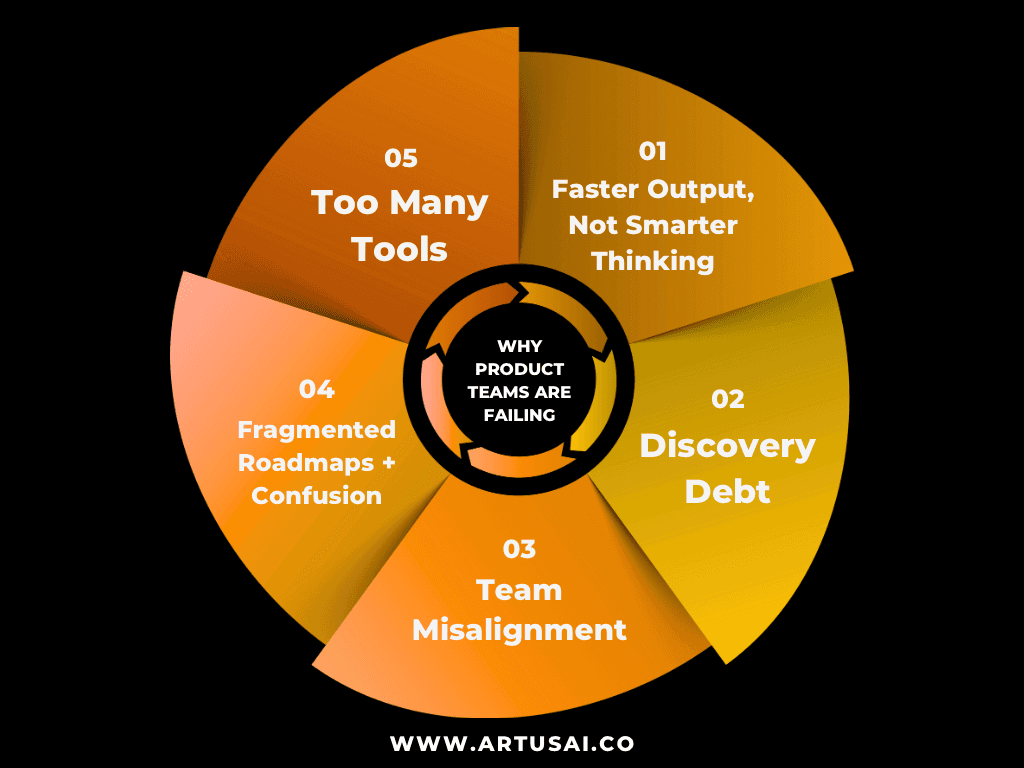
Product workflows became faster, not smarter.
New tools automated tasks, but not thinking.
AI accelerated output, but not alignment.
At Artus, we’ve spoken with hundreds of founders, PMs, and engineers who all echo the same quiet truth:
“We’re shipping more than ever, but understanding why we’re shipping anything has never felt harder.”
This article explains why speed without alignment is breaking teams, and why 2025 planning needs discipline, not more automation.
Tasks get done faster, tickets get filled, docs get written yet that doesn’t guarantee clarity on what problem you're solving or why.
Tools help you create tasks, generate ideas, fill roadmaps, and produce polished specs in minutes.
But none of that guarantees clarity on:
What problem you’re solving
Why it matters
How it connects to the product vision
This creates something we call Discovery Debt:
Features built on guesswork
Problems defined by assumption
Solutions created without constraints
Roadmaps filled with noise
Product-market fit drifting quietly out of reach
Every skipped discovery step compounds into months of rework.
📉 Real-World Example: Google Glass
What it was:
A futuristic AR wearable meant to redefine how people interact with the world.
What happened:
Google shipped world-class engineering, marketing, and hardware. But:
Users rejected it due to privacy concerns and social discomfort
The value prop was unclear (“Why would I use this?”)
The team built around a technology vision, not a validated user need
In other words:
Polished output ≠ aligned understanding of the problem.
Google automated invention, but not clarity.
Teams use AI to turn half-baked ideas into polished outputs but skip the hard and boring part: Discovery
This creates what we call Discovery Debt:
Features built on guesswork
Problems defined by assumption
Solutions created without constraints
Roadmaps filled with noise
Product-market fit drifting quietly out of reach
Every skipped discovery step compounds into weeks—or months—of future rework.
Each team member lives inside a different “truth,” a different slice of the product.
Every tool teams use embodies its own worldview:
Linear sees tasks
Notion sees documents
Figma sees UX
Analytics sees numbers
AI copilots see patterns in whatever data they're fed
Each team member ends up living inside a different truth.
So everyone is building the same product — but not the same version of it.
And the more automation you add, the faster these micro-truths diverge.
Your problem isn’t the tool stack.
It’s the absence of a unified planning model that sits above the stack.
📉 Real-World Example: Microsoft Teams vs. Skype
When Microsoft was building Teams while still running Skype (both communication tools under the same company), internal teams operated inside different truths, leading to years of confusion both internally and in the market.
What Happened?
Inside Microsoft:
The Skype team used data and analytics tools focused on call quality and reliability
→ Their “truth”: a communication product is about connection stability.
The Teams team was using collaboration and productivity metrics (engagement, messaging volume, channel activity)
→ Their “truth”: a communication product is about collaboration and workflow.
The Office 365 team worked inside SharePoint/OneDrive integrations
→ Their “truth”: a communication product is about document-sharing workflows.
Executives used dashboards showing enterprise adoption curves
→ Their “truth”: a communication product is about enterprise dominance and licensing.
These worldviews did not match.
Result?
❌ Two apps
❌ Two strategies
❌ Two roadmaps
❌ Two definitions of “team communication”
And for several years, even enterprise customers said:
“We don’t know whether to use Skype or Teams.”
Because Microsoft itself didn’t have a unified planning model sitting above its tool stack.
How Artus Could’ve Helped
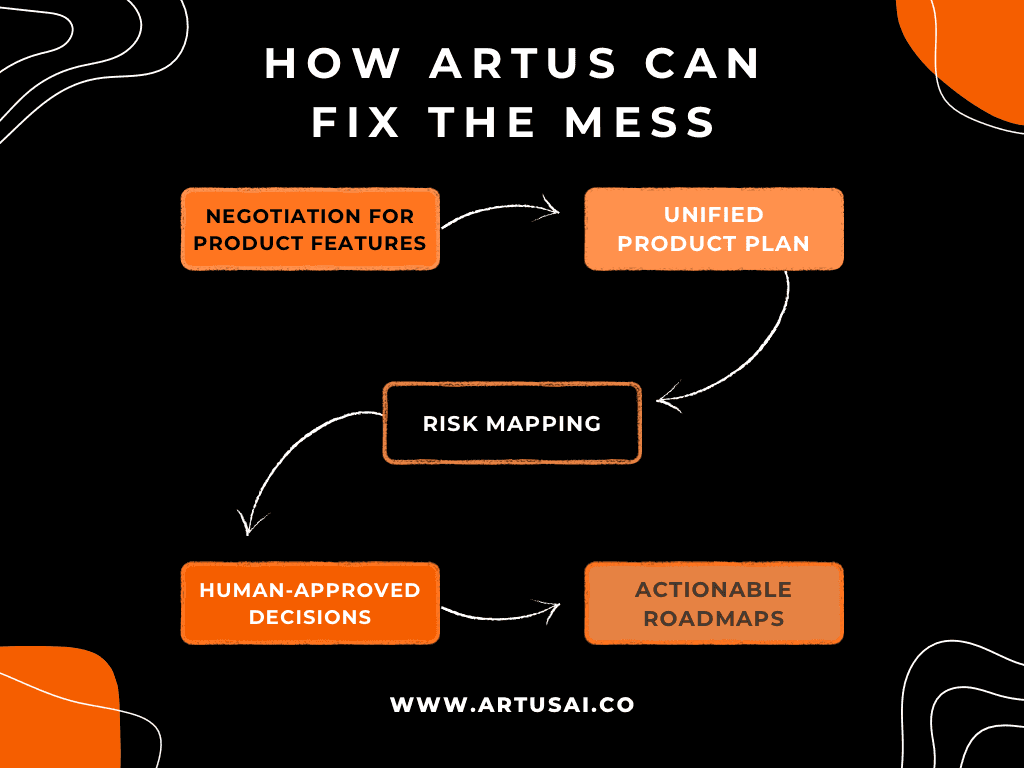
✔ Unified Product Definition
Artus allows teams to brainstorm collaboratively and decide on one shared product definition that all teams can reference — problem, users, constraints, and goals based on data, instead do assumptions.
✔ Negotiation for Features
Artus builds a semantic model of the product domain, so Teams, Skype, and Office 365 would be able to negotiate and come to terms with the same meaning of “communication.”
✔ Risk Mapping
Artus captures engineering, design, business, and compliance constraints, then flags conflicts before they become misaligned roadmaps. You get all potential future failures and risks before implementing a single line of code.
✔ Decision Fingerprinting
Every feature requirement and their details get chosen by the product manager and can be revised anytime during the planning process. You don’t build with AI, AI builds with you, for you and strengthens you.
✔ Actionable Roadmaps
Roadmaps flow from one aligned product model, so multiple teams cannot generate contradicting plans or parallel strategies. The plan is built on undefeatable level of clarity that cannot be questioned or pivoted from in the future. You avoid rework, are prepared for unpredictability and are ready to strike the market.
For example, with Artus, Microsoft would know before building Teams that the confusion between Skype and Teams would create misalignment both internally and externally among their customers. Beforehand, they would’ve been able to collaboratively decide on the most important differentiating features of the two apps and help it stand out with a unified sense of future vision.
When no one owns the decisions behind planning, the product becomes a collection of unchallenged assumptions
AI can now generate:
Specs
Backlogs
User stories
Competitive research
Product ideas
Roadmaps
But when everything is autogenerated, something dangerous happens:
Decisions lose fingerprints.
“Who wrote this requirement?” → “AI drafted it.”
“Why is this feature here?” → “It came from the backlog.”
“Who approved this direction?” → “It was summarized in Notion.”
Speed without ownership is just noise.
Final Thoughts: What 2025 Product Planning Actually Needs
Speed is no longer a strategy.
Shipping faster doesn’t save teams from building the wrong thing—thinking better does.
2025 belongs to teams that operate from a shared brain, not a shared backlog.
1. Unified Product Definition
A single, living model that grounds everyone in the same reality:
vision, constraints, risks, metrics, segments, success criteria.
Not scattered docs—one source of truth that replaces guesswork with clarity.
2. Discovery-First Workflows
Ideas don’t earn the right to become specs until they survive research, context mapping, and constraints testing.
Execution begins only after the problem is proven.
3. Decision Ownership & Traceability
Every decision carries a name, a rationale, a trade-off, and a timestamp.
No more “why did we do this?” archaeology.
4. Reality Checkpoints
Frequent alignment audits to ask:
“Is this still the real problem? Has anything changed?”
Teams that re-question assumptions stay ahead of teams that merely deliver.
5. Human-Led Judgment
AI can accelerate analysis, simulate paths, and surface blind spots—
but values, nuance, ethics, and user empathy cannot be automated.
Those remain the responsibility of human judgment.
Today’s tools help teams execute.
Almost none help teams think, align, and choose wisely—
the parts of product work that decide whether something succeeds or quietly dies.
And in a world where automation is the baseline, alignment becomes the only true competitive advantage.
With Artus, you don’t just move faster.
You skip the chaos, skip the rework, and start building from a place of clarity the industry has never truly had—until now.