" height="16.655689568565506px" id="sF6zVZNmi" transform="translate(0 0.675)" width="91.00000230951045px"/></svg>)
How the AI Era is Raising the Stakes for Product Teams

Yashika Vahi
Community Manager
Table of contents
Share
In 2026, product teams are accountable not just for planning, but profit outcomes, ethical compliance, and execution integrity simultaneously. Product planning is no longer a document—it’s risk management.
1) The expanding responsibility of product teams
Historically, product teams focused on features and delivery timelines. Today they own:
Financial impact — aligning features to measurable business outcomes
Regulatory/ethical compliance — especially in AI-driven, data-rich products
Operational integrity — live systems that must remain stable and secure
A Deloitte survey found that 67% of executives see risk oversight as a product leadership expectation, up significantly from earlier years, and that firms want product teams to align operational and strategic risk decisions. (Deloitte, 2025 Global Risk Management Survey)
2) Why planning is becoming a risk management discipline
Good planning in 2026 does more than estimate dates. It anticipates uncertainty and quantifies tradeoffs before committing resources.
In practice, this means:
modeling risk scenarios (financial, legal, operational)
incorporating compliance constraints before design
anticipating dependency failures (data, infra, third parties)
designing rollback or guardrail mechanisms
A 2024 McKinsey report on AI adoption noted that risk of harm from misaligned AI outputs is reported by more than half of companies deploying generative models, and that “robust risk frameworks are one of the most differentiating success factors.” (McKinsey, State of AI)
3) The necessary skills shift
Systems thinking
Product teams now need to reason across how a product behaves under real conditions: performance under load, data lifecycle risks, failure modes in complex systems, and cross-functional dependencies that span engineering, compliance, operations, and business teams.
Decision modeling
Product decisions increasingly require balancing expected value against cost of delay, operational risk against feature impact, and compliance burden against market opportunity. These are not judgment calls that improve with more meetings or stronger opinions. They are scenarios that can be modeled, compared, and stress-tested—often with AI support—to reveal which paths are resilient and which collapse under realistic constraints.
Strategic influence
Product leaders are also expected to translate complex decisions into economic and strategic terms that organizations can act on. That means framing choices around risk tolerance, return profiles, and long-term exposure, and aligning stakeholders using evidence rather than anecdotes.
A real-world example: Stripe
Stripe operates in one of the highest-risk product environments in tech. A small change in an API, checkout flow, or fraud model can immediately affect revenue capture, regulatory exposure across countries, merchant trust, and platform stability. In this context —uncontrolled speed is a liability.
Stripe’s response was not to slow delivery, but to move risk upstream into planning. Product decisions are framed with explicit economic and operational tradeoffs before work begins. Features are designed with known failure modes and rollback paths, and regulatory and compliance constraints are treated as design inputs rather than post-launch checks. Decision documents force teams to articulate why a path is chosen, what assumptions it relies on, and what risks it absorbs.
This approach allows Stripe to ship continuously while operating under intense regulatory and financial pressure. The differentiator is not execution quality alone; it is planning depth that absorbs risk before it reaches production.
How ArtusAI helps teams achieve similar control
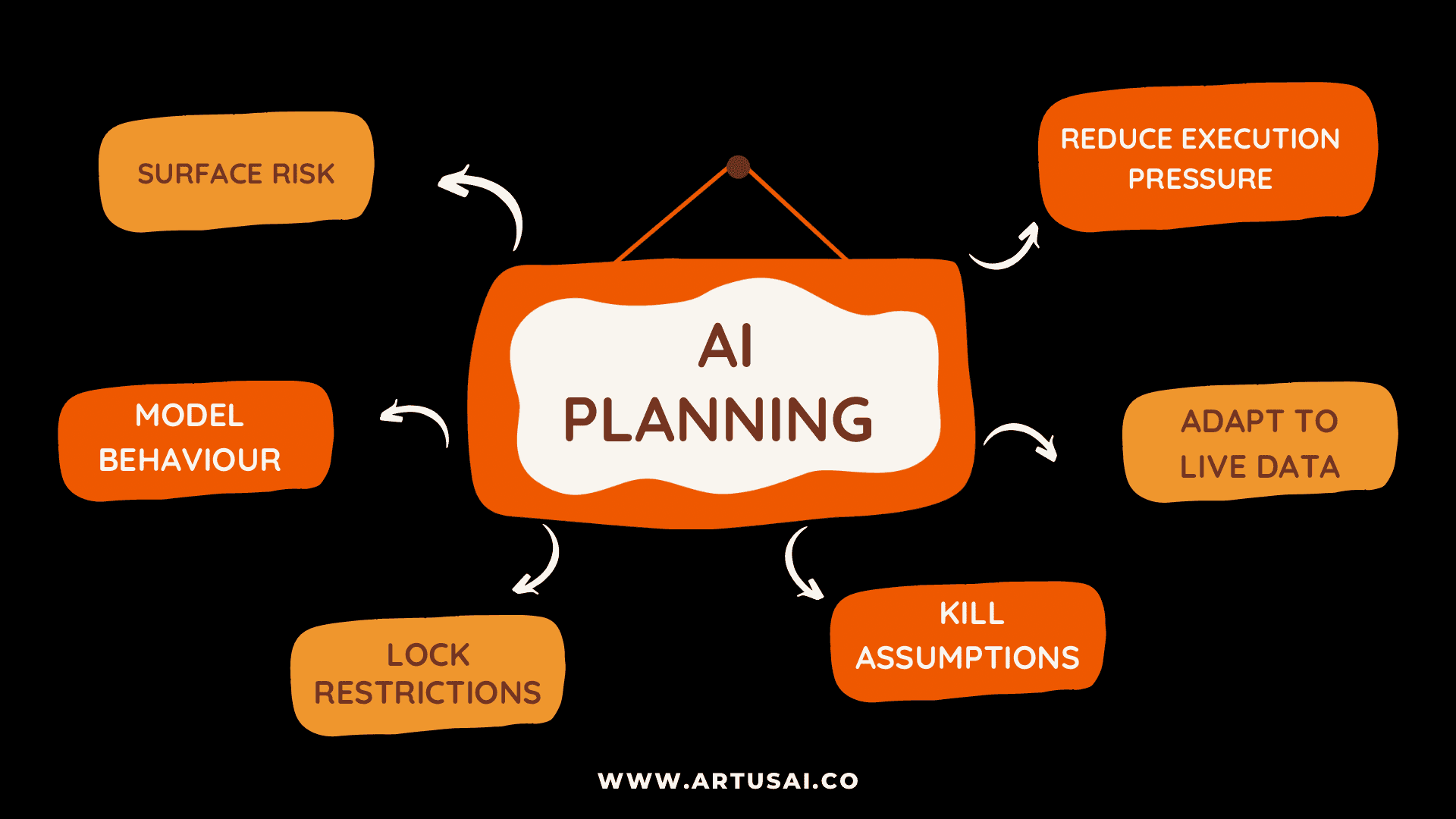
ArtusAI operationalizes what companies like Stripe do manually at scale.
In practice, ArtusAI helps teams:
Surface risk during planning
By generating multiple roadmap and feature paths and mapping dependencies, teams see where risk concentrates before committing engineering time.
Model decisions instead of debating opinions
ArtusAI frames tradeoffs explicitly: value vs. cost, speed vs. compliance, flexibility vs. lock-in, so planning becomes comparative, not political.
Lock constraints early
Teams define technical, regulatory, financial, and ethical boundaries upfront, shaping AI-generated plans around reality instead of revising later under pressure.
Reduce downstream pressure through clarity
When assumptions, dependencies, and risks are visible early, execution becomes calmer, not because teams work less, but because fewer surprises survive planning.
Stripe shows what happens when planning absorbs risk:
teams move fast without losing control.
ArtusAI gives product teams a way to build that same discipline,
without needing Stripe’s scale, headcount, or institutional memory.
In 2026, the difference between constant pressure and operational confidence is not effort.
It’s planning depth.