" height="16.655689568565506px" id="sF6zVZNmi" transform="translate(0 0.675)" width="91.00000230951045px"/></svg>)
Why Product Teams Don’t Pivot Anymore
The pivot was a symptom of bad planning — not a badge of agility.

Yashika Vahi
Community Manager
Table of contents
Share
The Pivot Is a 2015 Idea Living in a constantly evolving 2026 World
“Pivoting” made sense when:
feedback cycles were slow
data was sparse
products were simpler
markets were less volatile
In 2026, a pivot usually signals:
“We didn’t build a system that could adapt.”
Modern products don’t pivot.
They continuously re-shape.
Why Pivots Are Actually a Failure Mode
A pivot is rarely strategic.
It’s usually emotional.
It happens when too many assumptions were locked in early, risks weren’t isolated, the product identity was brittle or leadership waited too long to react.
By the time you “pivot,” you’re already behind.
Elite teams don’t change direction violently.
They course-correct constantly.
A Real-World Example: Netflix
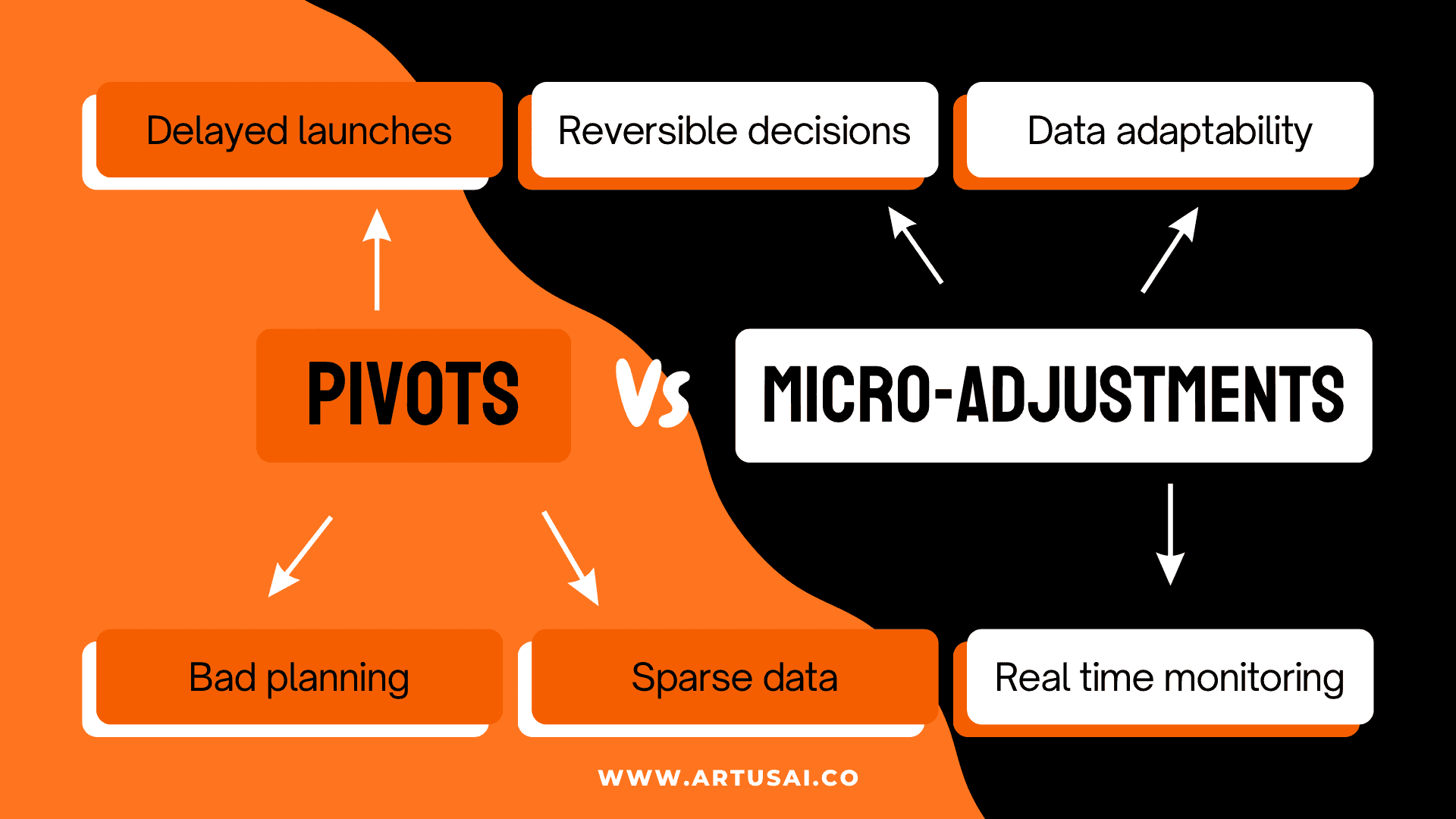
Netflix is a living example of how products evolve without ever “pivoting.” For years, Netflix has publicly described experimentation as a core part of its product system, not a side practice. The company runs hundreds of A/B tests every year, touching everything from homepage layout and artwork selection to playback behavior, recommendation ranking, notification timing, and even how content previews auto-play. What’s important is not the volume of experiments, but how early they are embedded into planning: features are rarely treated as permanent decisions. Instead, they are hypotheses designed to be tested, measured, and quietly adjusted based on real user behavior.
This is why Netflix never has an identity crisis. When something underperforms, it doesn’t trigger a dramatic roadmap reset or a public “pivot.” The signal simply weakens, rollout slows, the experiment is reverted or reshaped, and the product moves on. Planning at Netflix assumes uncertainty by default, so features are built to be reversible, scoped, and measurable from day one. The product evolves through micro-adjustments, not reinvention. The lesson for modern teams is sharp: if you need a pivot to change direction, you waited too long. Continuous experimentation, paired with clear success metrics and controlled rollouts, turns product planning into an adaptive system—one that absorbs change quietly instead of breaking loudly.
What Makes Micro-Adjustment Possible (and Why Most Teams Can’t Do It)
Micro-adjustment isn’t about being “agile.”
It’s about planning in a way that doesn’t trap you.
Most teams can’t course-correct because they lock themselves into assumptions they never wrote down, decisions they can’t reverse, and feedback that arrives too late to matter. Teams that adjust smoothly do the opposite—starting in discovery, not after launch.
1. Assumptions Are Made Explicit (Before Anything Is Built)
Every feature depends on something being true about users, behavior, costs, or constraints. Strong teams don’t treat those as background context; they write them down during discovery and scoping. They clearly state what must be true for a feature to work and what evidence would weaken that belief. This prevents teams from mistaking confidence for certainty. When assumptions are visible, they can be monitored. When they’re hidden, teams commit to them blindly and only discover they were wrong when reversal becomes expensive.
2. Signals Are Defined Early—and Watched Continuously
Micro-adjustment only works if teams know what to watch. During planning, strong teams decide which behaviors indicate real value, where friction is likely to appear, and which costs or usage patterns would signal trouble. AI systems help here by surfacing changes in usage, concentration of friction, rising costs, or shifts in behavior—but they don’t replace judgment. The key is timing. These signals are watched continuously, not reviewed quarterly. By the time most teams notice a problem, it has already hardened into a roadmap issue. Micro-adjustment teams see it forming while it’s still small.
3. Decisions Are Designed to Be Reversible
This is a planning discipline, not an engineering afterthought. During discovery, teams deliberately ask whether a feature can be slowed, reduced, paused, or redirected if the signal weakens. Features that can’t be adjusted safely are high-risk commitments, because they force dramatic pivots instead of controlled change. Reversibility gives teams room to learn without destabilizing the product or the organization.
Conclusion
When assumptions are clear, signals are live, and decisions are reversible:
change feels manageable, not catastrophic
course-correction happens early, not emotionally
teams evolve the product without disrupting users
planning remains calm even when conditions shift
This is why strong teams don’t “pivot” anymore.
They never let uncertainty build up to a breaking point.
Micro-adjustment works because it’s planned for from the start—
during discovery, during scoping, and before the product locks itself into the wrong future.